
AI in Restaurants Statistics 2026: Adoption, Use Cases & ROI
The Duckhub team builds QR menu and online ordering software, run through your own AI assistant (ChatGPT, Claude), used by cafes, bars, and restaurants. We write practical guides based on what we see working across thousands of published menus.
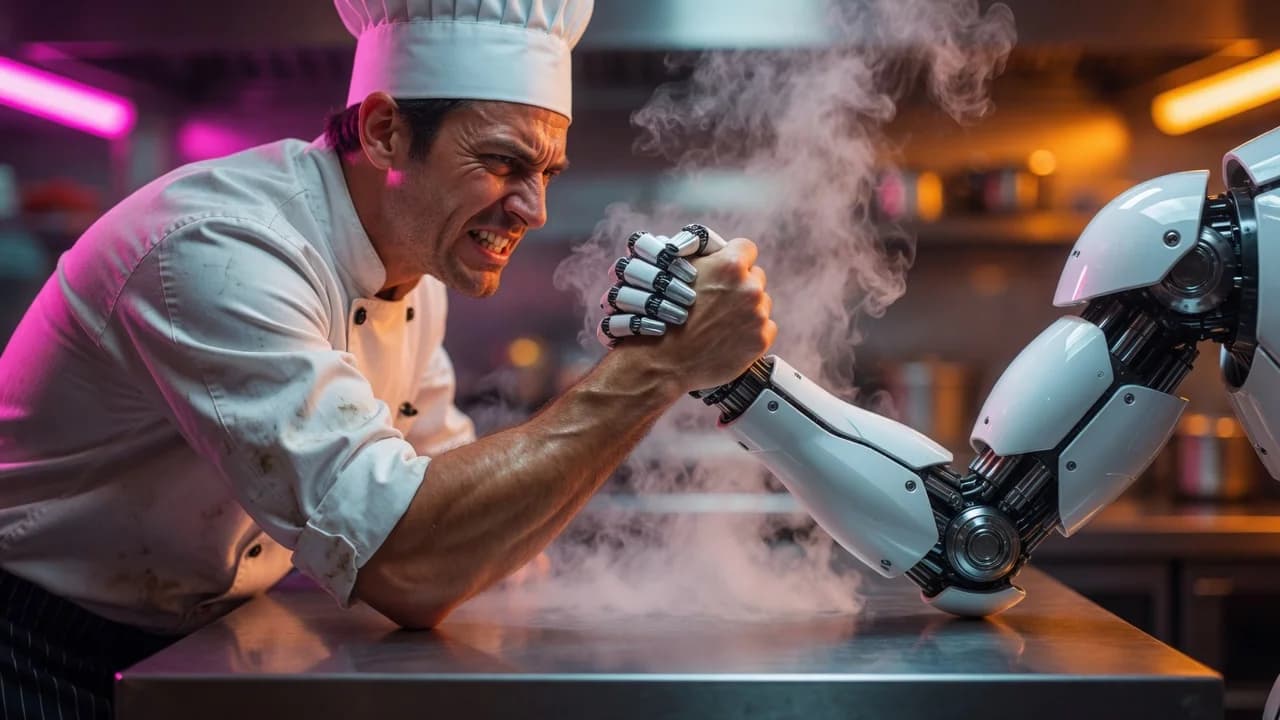
AI in restaurants statistics for 2026 tell two different stories depending on who is asking. The National Restaurant Association finds 26% of operators actively use AI tools; vendor surveys report adoption near 69%. Both are real numbers measuring different things — and this page explains the gap, then compiles 40+ verified statistics on use cases, spending, failures, and consumer behavior.
Every figure links to a named source with a date and is tagged Independent, Association, or Vendor. The most consequential shift is not in the kitchen at all: 45% of consumers now ask AI tools for local recommendations, while most restaurants are invisible in those answers. This hub is part of our restaurant data series anchored by the restaurant technology statistics pillar.
TL;DR: the AI restaurant numbers that hold up
- Real adoption is ~1 in 4: 26% of U.S. operators use AI-related tools (National Restaurant Association, February 2026). Vendor surveys reach 69% by counting planned adoption and sampling digital-first operators.
- Marketing is the #1 use case: 19% of full-service operators use AI for marketing; only 6% of operators use it for customer orders (NRA, 2026).
- Investment intent is near-universal: 82% of restaurant executives expect AI investment to increase; 2% expect a decrease (Deloitte, 375 executives, 11 countries).
- The drive-thru is the cautionary tale: McDonald’s ended its IBM voice AI test in 2024; Taco Bell publicly rethought its rollout in 2025 after an 18,000-water-cup prank order.
- Consumers are ahead of operators: 75% are comfortable with AI reservations, but only 28% of operators use AI for calls (DoorDash, 2026).
- AI discovery exploded: 45% of consumers use AI for local recommendations, up from 6% a year earlier (BrightLocal, 2026) — yet ChatGPT recommends only 1.2% of local businesses (SOCi, 2026).
How many restaurants actually use AI in 2026?
About one in four U.S. restaurant operators actively uses AI tools, and the higher numbers you see elsewhere include planners and pilots. The National Restaurant Association’s 2026 data puts active use at 26%. Popmenu’s 2026 study of 328 restaurant leaders reports 44% adopted plus 25% planning — the “69% of restaurants are adopting AI” headline.
| Statistic | What it measures | Source (date) | Quality |
|---|---|---|---|
| 26% | Operators actively using AI-related tools | National Restaurant Association (Feb 2026) | Independent (association) |
| 44% + 25% | Operators who adopted AI / plan to adopt in 2026 (the “69%” headline) | Popmenu, 328 U.S. restaurant leaders (Jan 2026) | Vendor (disclosed) |
| 86% | Operators who say they are comfortable using AI in their work | Toast, 712 U.S. decision-makers (Apr–May 2025) | Vendor (disclosed) |
| 81% | Operators who plan to increase their use of AI | Toast (2025) | Vendor (disclosed) |
The gap is methodological, not a contradiction. The NRA samples the broadest cross-section of the industry — including legacy independents — and asks about active, systemic use. Vendor surveys sample their own digitally forward customer bases and often count “piloting” and “planning” as adoption. The honest synthesis: deep operational AI sits around 26%, lightweight generative AI use is mainstream among digital-first operators, and intent is near-universal. When you cite an adoption number, say which kind it is.
What do restaurants use AI for? Use cases ranked
Marketing leads, back-office follows, and customer-facing AI trails far behind. The NRA’s breakdown shows AI concentrating where the risk is low: 19% of full-service and 15% of limited-service operators use AI for marketing, 10% for administrative tasks, and just 6% for customer orders. Toast’s AI survey of 712 decision-makers adds the tool-level detail.
| Statistic | What it measures | Source (date) | Quality |
|---|---|---|---|
| 19% / 15% | Full-service / limited-service operators using AI for marketing | National Restaurant Association (2026) | Independent (association) |
| 10% | Operators using AI for administrative tasks | National Restaurant Association (2026) | Independent (association) |
| 6% | Operators using AI for customer orders (voice drive-thru, ordering bots) | National Restaurant Association (2026) | Independent (association) |
| 55% | Digitally active operators using AI to write marketing content | Popmenu (2026) | Vendor (disclosed) |
| 28% | Operators automating marketing tasks with AI | Toast (2025) | Vendor (disclosed) |
| 27% | Operators using AI for real-time business insights | Toast (2025) | Vendor (disclosed) |
| 26% | Operators using AI to optimize menu writing and pricing | Toast (2025) | Vendor (disclosed) |
| 24% / 41% | Operators using AI for demand forecasting today / extremely likely to adopt it | Toast (2025) | Vendor (disclosed) |
| 22% / 42% | Operators using AI for competitive benchmarking today / extremely likely to adopt | Toast (2025) | Vendor (disclosed) |
The pattern is rational: text is cheap to fix, food is not. An AI-drafted menu description or social post gets reviewed before it ships; an AI-mangled drive-thru order costs food, time, and goodwill immediately. That is why menu-level AI — descriptions, translations, photos — is where small operators start; our guides to AI menu generators and creating a restaurant menu with AI cover that entry point.
AI investment and spending plans
Investment intent is the strongest signal in the entire data set: 82% of restaurant executives expect their AI spending to increase, and only 2% expect a decrease. Deloitte’s global survey (375 executives, 11 countries, fielded Q4 2024) found customer experience is the expected payoff for 60%, ahead of operations (36%) and loyalty (31%).
| Statistic | What it measures | Source (date) | Quality |
|---|---|---|---|
| 82% / 2% | Executives expecting AI investment to increase / decrease next fiscal year | Deloitte (2025) | Independent (consultancy) |
| 60% / 36% / 31% | Expected AI benefit areas: customer experience / operations / loyalty | Deloitte (2025) | Independent (consultancy) |
| 52% / 84% | Brands / operators already seeing high customer-experience impact from AI | Deloitte (2025) | Independent (consultancy) |
| 81% | Operators who believe AI will make them more efficient at work | Toast (2025) | Vendor (disclosed) |
| 78% | Operators who view AI tools as “great value for the money” | Toast (2025) | Vendor (disclosed) |
| 6 in 10 | Operators planning more investment in customer-experience technology broadly | National Restaurant Association (2026) | Independent (association) |
Note what is missing: hard ROI numbers. No independent, peer-reviewed study yet quantifies revenue lift or labor savings from restaurant AI at industry scale — the figures in circulation are vendor case studies. The closest honest benchmark is the technology-wide pair from the NRA’s 2025 research: 69% of tech adopters report efficiency gains, while only 28% of operators say technology improved profitability (detail in our restaurant technology statistics pillar).
What is holding restaurants back from AI?
The top two barriers are tied at 48%: finding the right use cases and managing risk. Deloitte’s readiness data explains why deployment lags intent — fewer than half of executives call their organization AI-ready on any dimension measured: strategy (43%), technology infrastructure (39%), operations (34%), risk and governance (28%), and talent (27%).
For independents the practical barriers are simpler: cost, integration with existing systems, and time. A single-location operator does not run an AI readiness program; they adopt AI when it arrives embedded in a tool they already need — the POS suggests a schedule, the menu platform drafts descriptions, the reservation system answers calls. That embedded path is how the 26% becomes 50%+ over the next few years without most operators ever “buying AI” as a line item.
Drive-thru voice AI: the public reality check
Voice AI at the drive-thru is the most visible restaurant AI application and its most documented failure story. Only 6% of operators use AI for customer orders (NRA, 2026), and the two biggest public deployments both hit walls. McDonald’s ended its IBM automated order-taking test in June 2024 after two and a half years, removing it from over 100 locations amid viral order errors (bacon on ice cream, nine unwanted sweet teas). Taco Bell said in 2025 it was rethinking its rollout after a prank order for 18,000 water cups — though it has since expanded the system to about 890 restaurants across 38 states.
| Event | What happened | Source (date) | Quality |
|---|---|---|---|
| McDonald’s–IBM test ended | AI order-taking removed from 100+ drive-thrus after ~2.5 years | CNBC (Jun 2024) | Independent (news) |
| Taco Bell rethink | Public reassessment after viral prank orders, incl. 18,000 waters | TechCrunch (Aug 2025) | Independent (news) |
| Taco Bell expansion anyway | Voice AI live in ~890 U.S. restaurants, 38 states | Restaurant Dive (2026) | Independent (news) |
| 6% | Operators using AI for customer orders industry-wide | National Restaurant Association (2026) | Independent (association) |
The lesson operators drew is not “AI fails” — it is where to put it. Both chains kept investing in AI; they moved the emphasis to kitchens, scheduling, and busy-store handoffs where a human takes over. Language models predict words; they do not natively understand that no one needs 18,000 waters. Systems that ship with hard business rules on top of the AI are the ones surviving contact with the public.
What do customers think about AI in restaurants?
Consumers are more ready for restaurant AI than restaurants are — for the right tasks. The clearest number is the expectation gap from DoorDash’s 2026 industry survey (3,000+ consumers and 500+ operators, fielded by Dynata in March 2026): 75% of consumers are comfortable using AI for reservations, while only 28% of operators use AI to manage calls and customer service.
| Statistic | What it measures | Source (date) | Quality |
|---|---|---|---|
| 75% | Consumers comfortable using AI for restaurant reservations | DoorDash / Dynata (Mar 2026) | Vendor (disclosed) |
| 28% | Operators using AI to manage calls and customer service | DoorDash / Dynata (Mar 2026) | Vendor (disclosed) |
| 22% | U.S. diners who have used an AI tool to choose a restaurant | DoorDash / Dynata (Mar 2026) | Vendor (disclosed) |
| 68% | U.S. consumers planning to cut back on restaurant dining in 2026 | Popmenu, 1,000 consumers (Feb 2026) | Vendor (disclosed) |
The context for all of it: 68% of consumers say they are cutting back on dining out in 2026. Guests are price-sensitive and convenience-hungry at the same time, which is exactly the combination that rewards AI in the booking-and-ordering layer (fast, frictionless, always answers the phone) and punishes AI that degrades the visit itself.
AI discovery: how diners now find restaurants
The fastest-moving statistic in this entire data set is who answers the question “where should we eat?” Per BrightLocal’s 2026 Local Consumer Review Survey (1,002 U.S. adults), 45% of consumers now use AI tools for local business recommendations — up from 6% a year earlier, making AI the third most-used discovery channel behind Google and Facebook, ahead of Yelp and TripAdvisor.
The supply side has not caught up. SOCi’s 2026 Local Visibility Index, which analyzed 350,000 business locations, found ChatGPT recommends only about 1.2% of local businesses — and 83% of restaurants do not appear in AI local recommendations at all.
| Statistic | What it measures | Source (date) | Quality |
|---|---|---|---|
| 45% (from 6%) | Consumers using AI for local recommendations, 2026 vs 2025 | BrightLocal (Feb 2026) | Independent |
| 64% | Share of 30–44-year-olds using AI for local recommendations (highest group) | BrightLocal (2026) | Independent |
| 22% | Diners who used AI specifically to choose a restaurant | DoorDash (2026) | Vendor (disclosed) |
| 1.2% | Share of 350,000 analyzed local businesses ChatGPT recommends | SOCi Local Visibility Index (2026) | Independent (analyst) |
| 83% | Restaurant locations absent from AI local recommendations | SOCi (2026) | Independent (analyst) |
For operators this is the new SEO, and the inputs are unglamorous: consistent name-address-phone data across platforms, recent reviews that mention specific dishes, and a menu that exists as structured, crawlable web data rather than a PDF or photo. An AI assistant cannot recommend a menu it cannot read — the same logic that applies to QR menus and AI readability applies doubly to discovery.
Disputed AI restaurant statistics you should not cite
AI is the most hype-dense corner of restaurant data, and several viral numbers do not survive tracing. These are the claims we checked and set aside while compiling this page.
| Popular claim | Why it fails | Use instead |
|---|---|---|
| “69% of restaurants use AI” | Combines 44% adopted with 25% planning, from a vendor-customer sample | NRA’s 26% active use, with the vendor figure cited as intent |
| “AI cuts restaurant labor costs 20–30%” | Circulates via aggregators with no traceable primary study | “No independent industry-scale ROI study exists yet” |
| “90%+ autonomous drive-thru completion” | Vendor metric that can exclude abandoned orders and silent human overrides | Named deployments and their documented rollbacks |
| “Dynamic pricing lifts restaurant revenue 8.7%” | Sourced to low-quality statistics aggregators, not a named study | “Dynamic pricing adoption is early and its restaurant ROI is unproven” |
| “Most consumers trust AI recommendations” | Trust is task-specific; comfort with research tasks does not extend to autonomous ordering | Task-level numbers: 75% comfortable with AI reservations (DoorDash) |
The common failure mode: a narrow, honest measurement gets stripped of its denominator and becomes an industry “fact.” AI statistics age faster than any other category in our series — this page is on a quarterly refresh cycle for exactly that reason.
The honest state of AI in restaurants, 2026
Restaurant AI in 2026 is a back-office success, a front-of-house experiment, and a discovery-layer revolution. One in four operators uses AI today, mostly for marketing and administration, where mistakes are cheap. Investment intent (82%) guarantees the number climbs, and the embedded path — AI arriving inside the POS, the menu platform, the reservation system — will do more for adoption than any standalone tool. The drive-thru saga taught the industry to keep deterministic guardrails between a language model and a live order. And the most under-appreciated shift is happening before the guest ever arrives: nearly half of consumers now ask AI where to eat, while five in six restaurants are invisible in the answer.
For the practical side of putting AI to work, see our guides to AI in restaurant management and the best AI tools for restaurant owners; for the full industry context, the restaurant technology statistics pillar holds the adoption, spending, and ROI data.
The lowest-risk place to start with restaurant AI is your menu. Duckhub lets your own AI assistant (ChatGPT or Claude) write dish descriptions and translate your menu into 10+ languages, then publishes it as a fast, structured web page that AI assistants can actually read and recommend — with 0% commission on orders on every tier. The free Egg plan includes 70 products and 30 QR table codes; paid plans start at $10/month. More data and guides on the Duckhub blog.